Generative Engine Optimization: what the research actually measured
A close reading of the 2023 paper that introduced Generative Engine Optimization, which methods improved visibility in AI-generated answers, which did not, and what the results do and do not show.
 Parsa Alizadeh
3 min read
On this page
Search is no longer only a list of links. More and more questions are answered by systems that read several sources and write one response. Writing for those systems now has a name, Generative Engine Optimization, and, unusually for a marketing term, it started as a research paper. This post summarises what that paper tested and found.
Definitions#
The paper is “GEO: Generative Engine Optimization” by Pranjal Aggarwal, Vishvak Murahari, Tanmay Rajpurohit, Ashwin Kalyan, Karthik Narasimhan and Ameet Deshpande, presented at KDD 2024 [1].
- Generative engine: a search engine that uses generative models to gather and summarise information to answer user queries [1].
- Generative Engine Optimization (GEO): in the authors' words, a paradigm to help content creators improve the visibility of their content in generative engine responses [1].
To evaluate it, the authors built GEO-bench, a large benchmark of user queries across multiple domains [1].
What was tested#
The paper evaluates nine ways of rewriting a source's content [2]:
| Method | The idea |
|---|---|
| Cite Sources | Add citations to credible sources |
| Quotation Addition | Add relevant quotations |
| Statistics Addition | Add quantitative statistics |
| Fluency Optimization | Improve how fluently the text reads |
| Easy-to-Understand | Simplify the language |
| Authoritative | Make the tone more persuasive and authoritative |
| Technical Terms | Add technical terminology |
| Unique Words | Add unusual words |
| Keyword Stuffing | Add more query keywords, as in classic SEO |
What worked#
The abstract reports that GEO methods can increase visibility in generative engine responses by up to 40% [1].
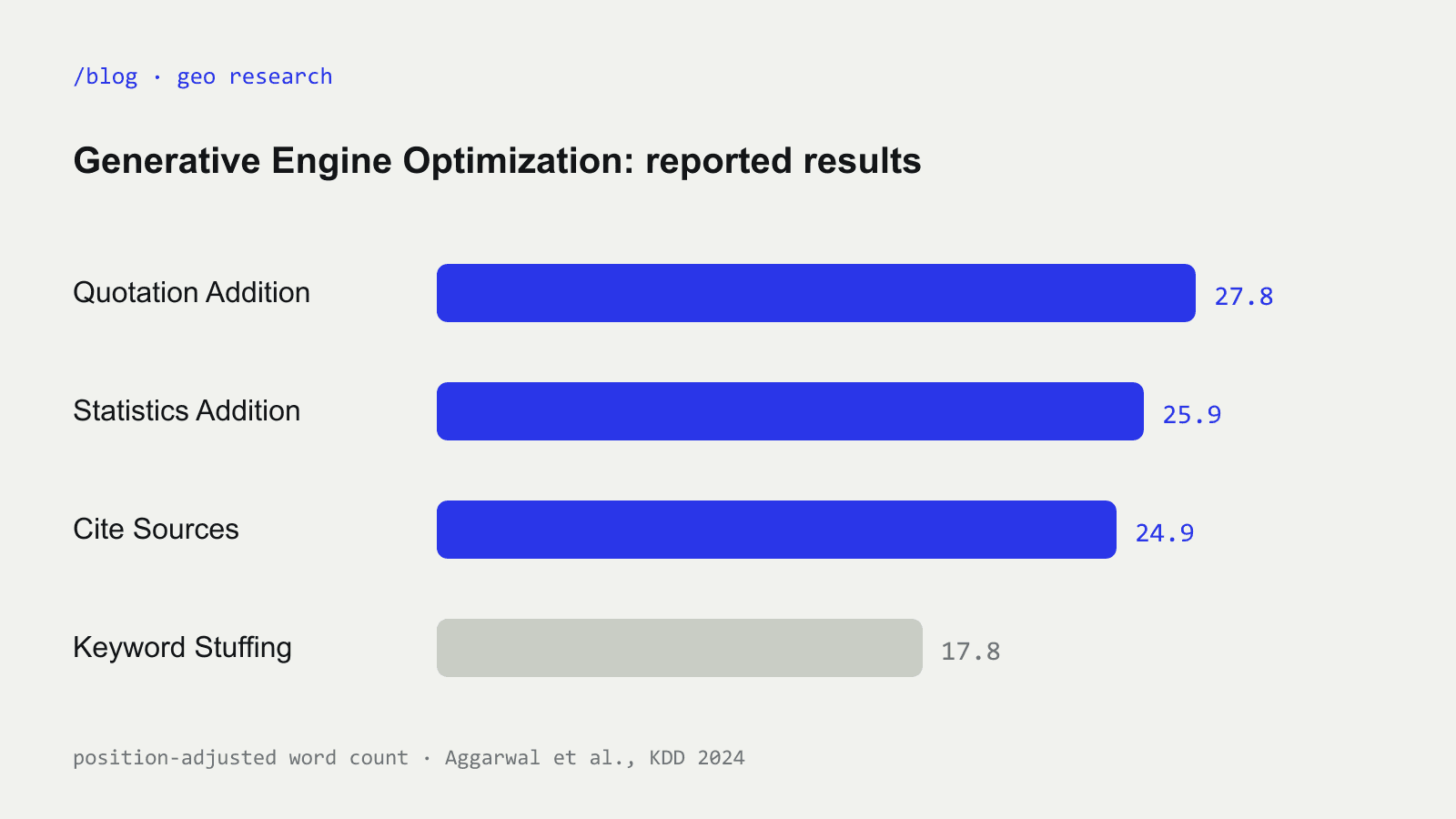
The three strongest methods in the paper's main results were Quotation Addition, Statistics Addition and Cite Sources [2]. On the paper's position-adjusted word count metric they scored 27.8, 25.9 and 24.9, while Keyword Stuffing, among the weakest, scored 17.8 [2]. The authors write that methods widely used for search engine optimization offered "little to no improvement" on generative engine responses [2].
A second result is about who benefits. For sources ranked fifth in a traditional search results page, the Cite Sources method increased visibility by 115.1%, while the visibility of the top-ranked source decreased by 30.3% on average [2]. In other words, adding evidence helped the sources that were not already winning.
What the results do not show#
It is easy to over-read a result like this, so the limits matter as much as the headline:
- It depends on the domain. The authors state that the efficacy of the strategies varies across domains [1]. There is no single recipe.
- It is a benchmark result. The measurements come from the paper's own benchmark and evaluation setup [1], not from every commercial AI search product.
- Visibility is not accuracy. The paper measures how visible a source is in a generated answer. It does not claim the answer is more correct.
How I apply it on this site#
The encouraging part is that the methods that worked are the same things that make writing trustworthy for people:
- Every article ends with numbered sources, and claims point to them inline, like [1] above.
- Numbers come from the source. When I quote a threshold or a result, it is the figure the source gives, with the source linked.
- Terms are defined before they are used, as in the Definitions section of this post.
- No keyword stuffing. The paper found it does not help [2], and it makes text worse to read.
The site also describes its author with structured data, which I covered in Structured data for a personal website.
Summary#
- GEO was introduced by Aggarwal et al. at KDD 2024 [1].
- Adding quotations, statistics and citations improved visibility the most; keyword stuffing was among the weakest [2].
- Lower-ranked sources gained the most from citing sources [2].
- Results vary by domain, so treat them as evidence, not guarantees [1].
Sources#
- Aggarwal, P., Murahari, V., Rajpurohit, T., Kalyan, A., Narasimhan, K., Deshpande, A. “GEO: Generative Engine Optimization.” KDD 2024. Abstract: https://arxiv.org/abs/2311.09735
- The same paper, full text (methods and results): https://arxiv.org/html/2311.09735
- #geo
- #seo
- #ai
- #search
- #research
Written by Parsa Alizadeh
I build web and mobile products end to end, and the AI tools that make them smarter. I care about fast interfaces, clean systems and shipping.