Structured data for a personal website: Person, ProfilePage and sameAs
How to describe yourself to search engines with JSON-LD, what Google's ProfilePage documentation asks for, and the rules that keep structured data honest.
 Parsa Alizadeh
3 min read
On this page
A personal website has one main subject: the person. Structured data is a way to say that explicitly, in a format search engines can read, instead of leaving them to infer it from the page. This post walks through the markup this site uses and the documentation behind each choice.
Why JSON-LD#
Google Search supports three formats for structured data: JSON-LD, Microdata and RDFa. Google recommends JSON-LD where the site's setup allows it, because it is the easiest to implement and maintain at scale [1]. JSON-LD lives in a <script type="application/ld+json"> block, separate from the HTML the reader sees, which keeps the markup out of the design.
ProfilePage: the page about a person#
Google's ProfilePage documentation describes the markup as meant for sites where creators, people or organizations, share first-hand perspectives. Its list of valid uses includes "About Me" pages on blogs and author pages [2].
ProfilePage has one required property, mainEntity, which must be a Person or an Organization [2]. Recommended properties for that person include name, alternateName, description, identifier, image and sameAs [2].
On this site, the ProfilePage is the About page, and its main entity is me.
sameAs: connecting your profiles#
Schema.org defines sameAs as the "URL of a reference Web page that unambiguously indicates the item's identity", for example a Wikipedia page, a Wikidata entry or an official website [3]. Google describes it for ProfilePage as "the URL to other external profiles or home pages for the profile" [2].
For a developer, that usually means the profiles you actually control, such as GitHub and LinkedIn. Only list profiles that are really yours. The point of sameAs is identity, and a wrong link weakens it.
One Person, referenced everywhere#
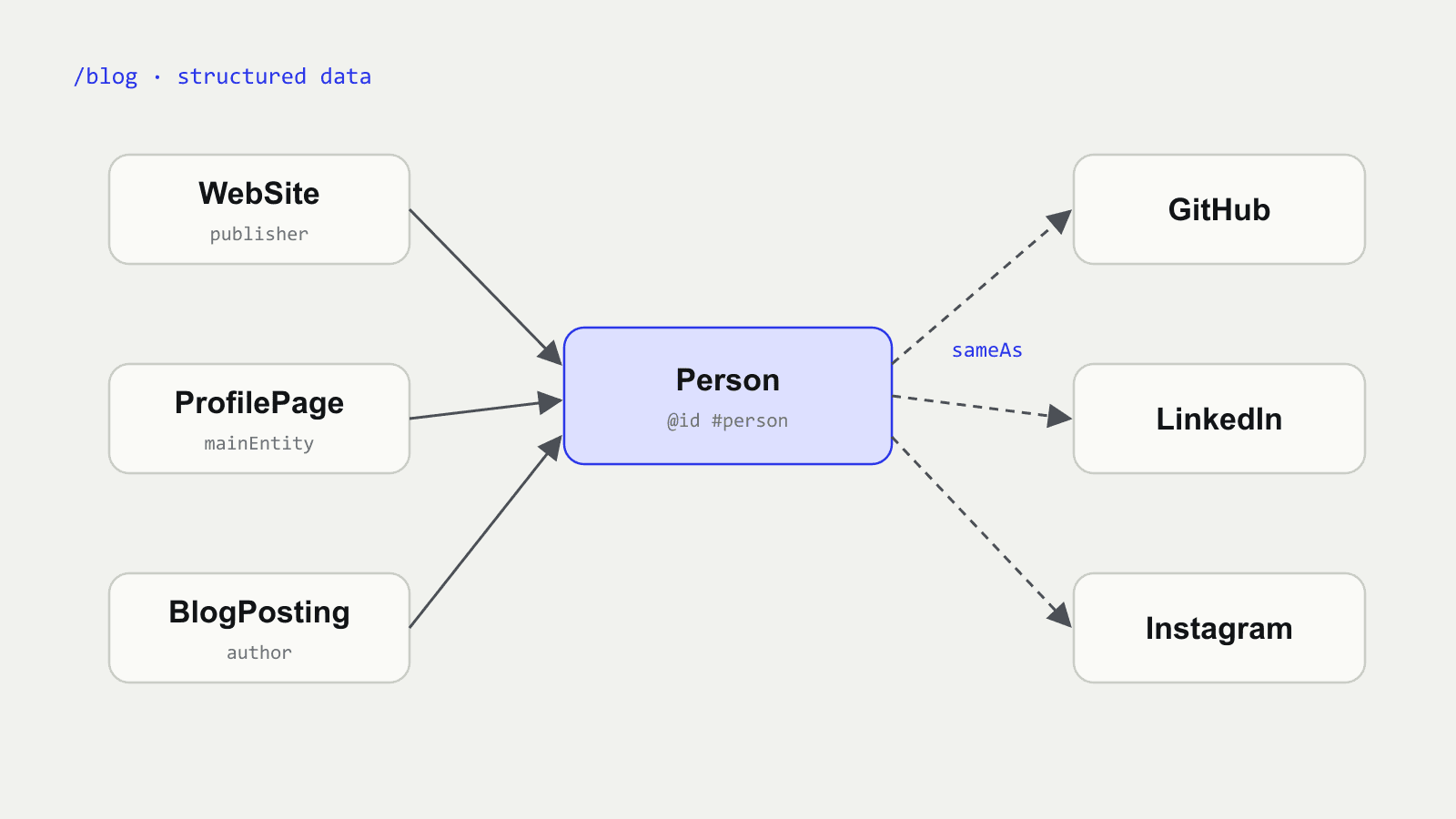
The most useful pattern I found is to define the person once, with a stable @id, and have every other node point to it:
{
  "@context": "https://schema.org",
  "@graph": [
    {
      "@type": "Person",
      "@id": "https://example.com/#person",
      "name": "Parsa Alizadeh",
      "jobTitle": "Software Developer",
      "sameAs": [
        "https://github.com/Coreinet",
        "https://www.linkedin.com/in/parsa-alizadeh-123237240/"
      ]
    },
    {
      "@type": "ProfilePage",
      "mainEntity": { "@id": "https://example.com/#person" }
    }
  ]
}
The WebSite node names the same @id as its publisher, and every blog post names it as the author. The result is one consistent entity instead of several unconnected descriptions of the same person.
The rules that keep it honest#
Google's general structured data guidelines are short and strict [4]:
- Structured data must be a true representation of the page content.
- Do not mark up content that is not visible to readers of the page.
- Do not use it to deceive or mislead, or to impersonate anyone.
It is also worth knowing what structured data does not do. Google does not guarantee that it will show up in search results, even when the markup is correct [4]. Correct markup makes a page eligible for richer results. It is not a ranking switch.
A checklist for your own site#
- Use JSON-LD [1].
- Mark the page that is about you as a ProfilePage with a Person as
mainEntity[2]. - Give the Person a stable
@idand reference it from the rest of the graph. - Add
sameAslinks only to profiles that are really yours [3]. - Make sure every value in the markup is visible on the page [4].
For the performance side of the same site, see what fixing LCP taught me.
Sources#
- Google Search Central, “Introduction to structured data markup in Google Search”, https://developers.google.com/search/docs/appearance/structured-data/intro-structured-data
- Google Search Central, “Profile page (ProfilePage) structured data”, https://developers.google.com/search/docs/appearance/structured-data/profile-page
- Schema.org, “sameAs”, https://schema.org/sameAs
- Google Search Central, “General structured data guidelines”, https://developers.google.com/search/docs/appearance/structured-data/sd-policies
- #seo
- #structured-data
- #json-ld
- #schema-org
Written by Parsa Alizadeh
I build web and mobile products end to end, and the AI tools that make them smarter. I care about fast interfaces, clean systems and shipping.